O Shyama, Thou Art Flying Kites

by Ramprasad Sen

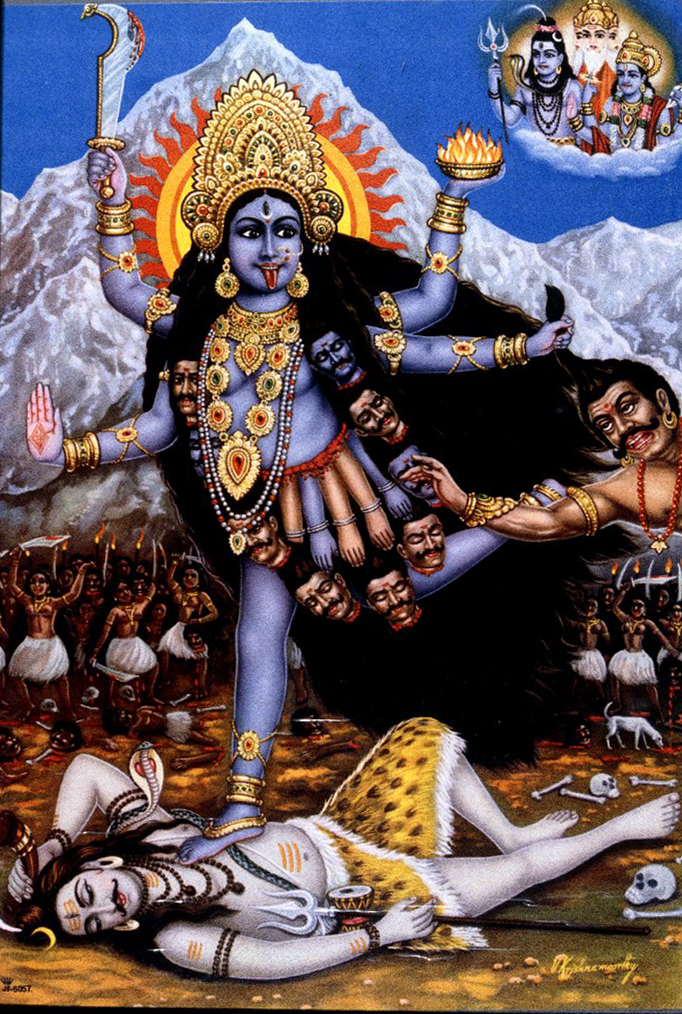
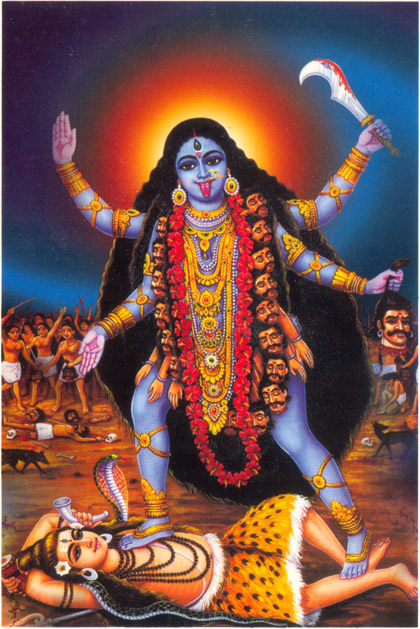
Kali postcard

Kali

In the world’s busy market-place, O Shyama,
Thou art flying kites;
High up they soar on the wind of hope,
held fast by maya’s string.
Their frames are human skeletons,
their sails of the three gunas made;
But all their curious workmanship
is merely for ornament.

Upon the kite-strings Thou hast rubbed
the manja-paste of worldliness,
So as to make each straining strand
all the more sharp and strong.
Out of a hundred thousand kites,
at best but one or two break free;
And thou dost laugh and clap Thy hands,
O Mother, watching them!

On favoring winds, says Ramprasad,
the kites set loose will speedily
Be borne away to the Infinite,
across the sea of the world.

—from Kali: The Black Goddess of Dakshineshwar by Elizabeth U. Harding

Note: Shyama Kali is the more tender aspect of Kali. She is worshiped in many households as the dispenser of boons and dispeller of fear.

Posted in divine mother, kali, ramprasad, shyama | Tagged , , , , | Leave a comment

You Haven’t Seen How Kali Is

by Ramprasad Sen

Kali

Kali

Mind, you’re still not rid of your illusions;
you haven’t seen how Kali is.
You know the Mother manifests
as the three worlds,
but you seem not to know it,
______really.

That Mother who adorns the world
with countless jewels and gold
___aren’t you ashamed to decorate Her
______with trashy tinsel?

That Mother who feeds the world
with myriad tasty treats
___aren’t you ashamed to offer Her
______rice you’ve laid out in the sun, and
______wet chick peas?

If you really knew the Mother who
protects the world with such care,
would you sacrifice
sheep, buffalos, and young goats?

Prasad says,
Devotion is the only true way to worship Her,
You may do rituals to impress other people,
______but the Mother won’t be bribed.

From Singing to the Goddess: Poems to Kali and Uma from Bengal
by Rachel Fell McDermott


Posted in cosmic mother, kali, ramprasad, yogananda | Tagged , , | 1 Comment

Ways of Approaching God

by Paramhansa Yogananda

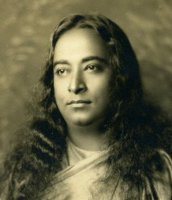
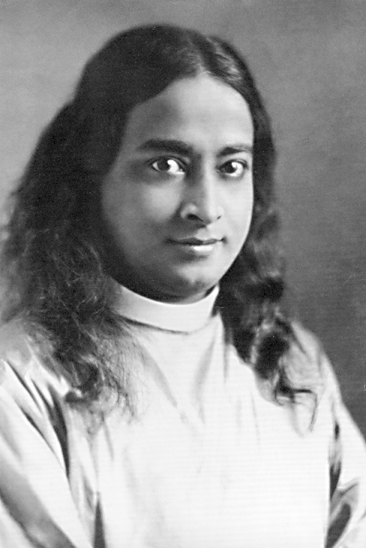
Paramahansa Yogananda

Paramhansa Yogananda

“There are two ways of approaching God in Nature. One is to separate the Lord from all His manifestations. ‘Neti, neti,’ is the saying in India: ‘Not this, not that.’ Something of that consciousness there must always be, lest one become trapped in attachment to form.

“The other way is to behold the Lord manifested everywhere.

“The first way, by itself, may be too austere for most devotees. The second way is much sweeter. Best of all is a combination of both.

“The Divine Mother is busy with Her housework of creation. The baby devotee cries, and She gives him a toy to play with—riches, perhaps, or name, or fame. If he cries again, She gives him another toy. But if the baby throws everything away and cries for Her love alone, She picks him up at last and whispers to him lovingly, ‘If you really want only Me, and not My gifts, then come. Be with Me forever on My lap of infinity.’”

        *         *         *         *         *         *         *

A Hindu student in America once laughingly told Paramhansa Yogananda, “My grandmother in India listens to bhajans [devotional songs] on the radio. At the end of the singing, she places a flower on it as a devotional offering—as if the radio were a holy image!”

The Master smiled at this encounter between scientific materialism and traditional piety. “And yet,” he commented, “your grandmother is not so superstitious as she seems. For with the flower she is expressing her gratitude to God. It isn’t that she views the radio as a deity. She is simply seeking an external focus for her devotion.

“And isn’t it good to see God enshrined everywhere? We think of the radio as man-made, but from Whom came the intelligence that made the radio? From Whom came even the materials from which it was created?

“When we seek to remove God from our environment, it becomes all too easy for us to remove Him from our lives altogether.”

—from The Essence of Self-Realization by Swami Kriyananda

Posted in cosmic mother, divine mother, yogananda | Leave a comment

“Why not worship the Infinite as your Divine Mother?”

Paramahansa Yogananda

Paramhansa Yogananda

“I have trouble visualizing God,” complained a student of religious New Thought. “I’ve imagined Him as Infinite Intelligence, as the I AM principle, as my God-Self within, as the Cosmic Ground of Being. It all seems so abstract! But your relationship with the Lord is so loving. How can I achieve such a relationship?”

“The first step,” replied the Master, “is not to imagine that He wants your definitions. He wants only your love.

“Why not,” Yogananda then suggested, “worship the Infinite as your Divine Mother?”

“What a lovely idea!” exclaimed the visitor. “But is it valid? Is it true?”

“Indeed, yes!” replied Sri Yogananda emphatically. “God’s love is already reflected in human relationships. His love, like the sunlight shining on countless pieces of glass, is reflected everywhere.

“The Infinite is the Mother behind all human mothers, the true Father behind all human fathers. He is the ever-loyal Friend behind all earthly friends. He is the eternal Beloved behind all human loves. He is all things to all men, because, you see, the Lord is everything.

“Through your parents He cares for you, supports you, and protects you. Through your friends He shows you that love is a free sharing, without any hint of compulsion. Through the beloved He helps one to find the selfless intensity of divine love. Through people’s children He helps them to understand love as something precious, as a thing to be protected from harmful influences and nourished with devotion.

“Countless are the forms in which God comes to man. In each, He seeks to teach man something of His infinite nature. The lessons are there, for anyone whose heart is open to receive them.

“Thus, it isn’t that the Lord wants you to deny your human nature. What He wants, rather, is for you to purify it: to expand whatever love you feel in your heart, and not to keep it locked up in ego-attachments.

“For the devotee, it is natural therefore to worship God in some human aspect: as his Divine Mother, for example, or as his Heavenly Father.

“I myself worship the Mother aspect, especially. For the Mother is closer than the Father. The Father aspect of God represents that part which is aloof from His creation. The Mother is creation itself. Even among mankind, the human father is more disposed than the mother to judge their erring children. The mother always forgives.

“Pray, then, to the Divine Mother. Talk to Her like a child: ‘Divine Mother, naughty or good, I am Your own. You must release me from this delusion.’ The Mother ever responds with compassion when the devotee prays to Her sincerely in this way.

“Of course, in the highest sense God is none of the forms in which people worship Him. But it is helpful to use human concepts as a means of deepening our devotion to Him.

“Beyond devotion comes divine love. In that perfection of love there is complete union. In that state the yogi realizes the supreme truth: ‘I am That.’”

— Paramhansa Yogananda, The Essence of Self-Realization

Posted in cosmic mother, divine mother, yogananda | Tagged , | Leave a comment

Who Is Divine Mother?

by Swami Kriyananda
from Clarity Magazine
Fall 2001

First of all, we need to understand that Divine Mother is not a separate thing or person, but is the feminine aspect of God. There’s really only one reality—the Infinite Consciousness that has produced all the different manifestations we see. But there can be different expressions of the Divine that appeal to people according to their own natures.

Some years ago it came to me in meditation that what America needs is more consciousness of the Divine Mother to balance out the overly masculine, intellectual approach that is dominant here. With all our great mental insights, we’ve failed to realize one simple truth: this world is not real.

In essence, we are a part of the Infinite, and it’s God who’s playing our particular role in life. God is uniquely present in each one of us, and has His own song to sing through everyone. The whole purpose of this great drama is to realize that you are God.

But we must be careful. We can’t correctly say, “This body is God. This personality is God.” No. But God is you—this is correct. In the end, Self-realization means to know that the whole universe is a part of our own reality, and that in our basic nature, we are infinite.

You are Divine Mother
Now, who is Divine Mother? You are Divine Mother.  There can’t be any difference, because there’s no separation in the Infinite. When God brought this universe into existence, He could only do it out of His own consciousness. He had to dream it into existence. The beauty of this thought is that all the love of the universe is also a part of you.

What part does Divine Mother play in this? She gives us a form towards which we can direct our love. It’s not wise to say, “When I love myself I’m loving God,” because then you’re thinking of the wrong self. So it’s helpful to think of God as something outside and separate from us. Divine love is without limit or form, but human love tends to take the Infinite and condense it into one person. This tendency is good in the sense that it gives you a focus for love, without which it would be vague.

We need a concrete concept of God—a beloved, or friend, or wise person—even though He is really without form. Having a concrete image is like having stepping stones that bring us to the point where suddenly we see it’s all Him.

Tuning into Divine Mother
To develop devotion for Divine Mother, in the beginning we often need to think in terms of a human form. When I first came to Paramhansa Yogananda, I was tired of being intellectual and wanted to develop devotion. I began praying to Divine Mother, and used to visualize the face of my godmother. That may seem ridiculous, but she had a very loving nature that reminded me of the innocence and sweetness that I was trying to develop. In this way, I gradually tuned into the consciousness of Divine Mother, so that when I think of Her now, I don’t think of any form.

The trouble with worshiping God only as Father is that He tends to present an image of a judge—somewhat stern and aloof. But Divine Mother is filled with compassion, and will forgive you even if you’ve done wrong. Yogananda said, “Pray to the Mother, ‘Naughty or good, still I’m your child, and you must help me.’”

God is all forms and no forms. I don’t ask people, “In what form do you worship God?”  I don’t ask the people at Ananda to worship God as Divine Mother. I think that many of them do—I do. But I don’t say that they have to, or even that they should, because in each one of us there is some form of God that deeply satisfies us.

There’s a very interesting story about Sri Yukteswar that I’ve mentioned it in my new book, A Place Called Ananda. Sri Yukteswar had a young disciple who was very dedicated, but still had a longing for human love. One day they were on a train, and Sri Yukteswar said, “Divine Mother will answer your prayer today.” After a time they stopped at a station, and he pointed, saying, “Look out the window.” Sitting in a train opposite them was a girl who somehow was the complete fulfillment of all his desires. From that mere glimpse of her, he had no more desire for human love.

Never lose sight of the Infinite
We need the limited to remind us of the Infinite. But even if God should come to you as the Divine Mother, or as a friend, or a beloved, always see the Infinite Consciousness behind those eyes. This is what Yogananda taught us to do. I used to notice with Yogananda that he could be laughing joyfully, or scolding, or teaching, or talking about a pothole in the driveway that needed fixing, but when I looked into his eyes, I saw that there was no personal desire. It was as if the Infinite was looking at me through those eyes.

I’ll never forget once when I was sitting at his feet while he was editing a manuscript, and I was thinking how fortunate it was that I had found him. When he finished his editing, he asked me to help him stand. He looked into my eyes with so much joy and love, and said, “Just a bulge of the ocean.”

I was loving the form, but it’s the ocean that has produced that form. It’s the ocean that has produced all our forms. Ultimately, love of Divine Mother is only love of your own true self. You need always to bring it back to that reality, not in self-love, but in the realization that God is everywhere, and you, too, are everywhere.

As Yogananda wrote in a letter to his chief disciple, Rajarsi Janakananda, “Don’t look just with your physical eyes. Think of things behind you that are out of your range of physical vision, and try to see them. In this way, bit by bit, you will develop omnipresence.” This is how we worship Divine Mother.

Excerpted from a satsang with Swami Kriyananda at Ananda’s Retreat Center in Rhode Island a few days before Mothers’ Day 2001.

Posted in cosmic mother, divine mother, kriyananda, yogananda | Tagged , , , | 1 Comment

A Meeting with Master Mahasaya

From A Search in Secret India
by Paul Brunton

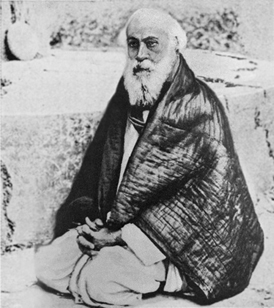
Master Mahasaya, disciple of Ramakrishna known as "M." and teacher to Paramhansa Yogananda

Master Mahasaya, disciple of Ramakrishna known as “M.” and teacher to Paramhansa Yogananda

And so I am now in Calcutta itself, searching for the house of the Master Mahasaya, the aged disciple of Ramakrishna.

Passing through an open courtyard which adjoins the street, I reach a steep flight of steps leading into a large, rambling old house. I climb up a dark stairway and pass through a low door on the top storey. I find myself in a small room, which opens out on to the flat, terraced roof of the house. Two of its walls are lined with low divans. Save for the lamp and a small pile of books and papers, the room is otherwise bare. A young man enters and bids me wait for the coming of his master, who is on a lower floor.

Ten minutes pass. I hear the sound of someone stirring from a room on the floor below out into the stairway. Immediately there is a tingling sensation in my head and the idea suddenly grips me that that man downstairs has fixed his thoughts upon me. I hear the man’s footsteps going up the stairs. When at last – for he moves with extreme slowness – he enters the room, I need no one to announce his name. A venerable patriarch has stepped from the pages of the Bible, and a figure from Mosaic times has turned to flesh. This man with bald head, long white beard, and white moustache, grave countenance, and large, reflective eyes; this man whose shoulders are slightly bent with the burden of nearly eighty years of mundane existence, can be none other than the master Mahasaya.

He takes his seat on a divan and then turns his face towards mine. In that grave, sober presence I realize instantly that there can be no light persiflage, no bandying of wit or humour, no utterance even of the harsh cynicism and dark scepticism which overshadow my soul from time to time. His character, with its commingling of perfect faith in God and nobility of conduct, is written in his appearance for all to see.

He addresses me in perfectly accented English:

“You are welcome here.”

He bids me come closer and take my seat on the same divan. He holds my hand for a few moments. I deem it expedient to introduce myself and explain the object of my visit. When I have concluded speaking, he presses my hand again in a kindly manner and says:

“It is a higher power which has stirred you to come to India, and which is bringing you in contact with the holy men of our land. There is a real purpose behind that, and the future will surely reveal it. Await it patiently.”

“Will you tell me something about your master Ramakrishna?”

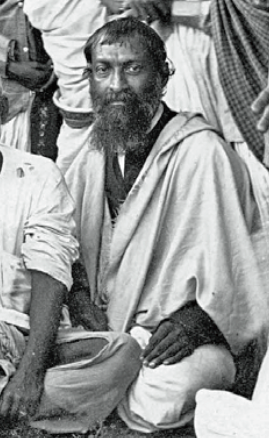
Master Mahasaya (Mahendranath Gupta) c. 1900

Master Mahasaya (Mahendranath Gupta) c. 1900

“Ah, now you raise a subject about which I love best to talk. It is nearly half a century since he left us, but his blessed memory can never leave me; always it remains fresh and fragrant in my heart. I was twenty-seven when I met him and was constantly in his society for the last five years of his life. The result was that I became a changed man; my whole attitude towards life was reversed. Such was the strange influence of this god-man Ramakrishna. He threw a spiritual spell upon all who visited him. He literally charmed them, fascinated them. Even materialistic persons who came to scoff became dumb in his presence.”

“But how can such persons feel reverence for spirituality – a quality in which they do not believe?” I interpose, slightly puzzled.

The corners of Mahasaya’s mouth pull up in a half smile. He answers:

“Two persons taste red pepper. One does not know its name; perhaps he has never even seen it before. The other is well acquainted with it and recognizes it immediately. Will it not taste the same to both? Will not both of them have a burning sensation on the tongue? In the same way, ignorance of Ramakrishna’s spiritual greatness did not debar materialistic persons from ‘tasting’ the radiant influence of spirituality which emanated from him.”

“Then he really was a spiritual superman?”

“Yes, and in my belief even more than that. Ramakrishna was a simple man, illiterate and uneducated – he was so illiterate that he could not even sign his name, let alone write a letter. He was humble in appearance and humbler still in mode of living, yet he commanded the allegiance of some of the best-educated and most-cultured men of the time in India. They had to bow before his tremendous spirituality which was so real that it could be felt. He taught us that pride, riches, wealth, worldly honours, worldly position are trivialities in comparison with that spirituality, are fleeting illusions which deceive men. Ah, those were wonderful days! Often he would pass into trances of so palpably divine a nature that we who were gathered around him then would feel that he was a god, rather than a man. Strangely, too, he possessed the power of inducing a similar state in his disciples by means of a single touch; in this state they could understand the deep mysteries of God by means of direct perception. But let me tell you how he affected me.

“I had been educated along Western lines. My head was filled with intellectual pride. I had served in Calcutta colleges as Professor of English Literature, History and Political Economy, at different times. Ramakrishna was living in the temple of Dakshineswar, which is only a few miles up the river from Calcutta. There I found him one unforgettable spring day and listened to his simple expression of spiritual ideas born of his own experience. I made a feeble attempt to argue with him but soon became tongue-tied in that sacred presence, whose effect on me was too deep for words. Again and again I visited him, unable to stay away from this poor, humble but divine person, until Ramakrishna one day humorously remarked:

“A peacock was given a dose of opium at four o’clock. The next day it appeared again exactly at that hour. It was under the spell of opium and came for another dose. ‘

“That was true, symbolically speaking. I had never enjoyed such blissful experiences as when I was in the presence of Ramakrishna, so can you wonder why I came again and again? And so I became one of his group of intimate disciples, as distinguished from merely occasional visitors. One day the master said to me:

“I can see from the signs of your eyes, brow and face that you are a Yogi. Do all your work then, but keep your mind on God. Wife, children, father and mother, live with all and serve them as if they are your own. The tortoise swims about in the waters of the lake, but her mind is fixed to where her eggs are laid on the banks. So, do all the work of the world but keep the mind in God.”

“And so, after the passing away of our master, when most of the other disciples voluntarily renounced the world, adopted the yellow robe, and trained themselves to spread Ramakrishna’s message through India, I did not give up my profession but carried on with my work in education. Nevertheless, such was my determination not to be of the world although I was in it, that on some nights I would retire at dead of night to the open veranda before the Senate House and sleep among the homeless beggars of the city, who usually collected there to spend the night. This used to make me feel, temporarily at least, that I was a man with no possessions.

“Ramakrishna has gone, but as you travel through India you will see something of the social, philanthropic, medical and educational work being done throughout the country under the inspiration of those early disciples of his, most of whom, alas! have now passed away too. What you will not see so easily is the number of changed hearts and changed lives primarily due to this wonderful man. For his message has been handed down from disciple to disciple, who have spread it as widely as they could. And I have been privileged to take down many of his sayings in Bengali; the published record has entered almost every household in Bengal, while translations have also gone into other parts of India. So you see how Ramakrishna’s influence has spread far beyond the immediate circle of his little group of disciples.”

Mahasaya finishes his long recital and relapses into silence. As I look at his face anew, I am struck by the non-Hindu colour and cast of his face. Again I am wafted back to a little kingdom in Asia Minor, where the children of Israel find a temporary respite from their hard fortunes. I picture Mahasaya among them as a venerable prophet speaking to his people. How noble and dignified the man looks! His goodness, honesty, virtue, piety and sincerity are transparent. He possesses that self-respect of a man who has lived a long life in utter obedience to the voice of conscience.

“I wonder what Ramakrishna would say to a man who cannot live by faith alone, who must satisfy reason and intellect?” I murmur questioningly.

“He would tell the man to pray. Prayer is a tremendous force. Ramakrishna himself prayed to God to send him spiritually inclined people, and soon after that those who later became his disciples or devotees began to appear.”

“But if one has never prayed – what then?”

“Prayer is the last resort. It is the ultimate resource left to man. Prayer will help a man where the intellect may fail.”

“But if someone came to you and said that prayer did not appeal to his temperament. What counsel would you give him?” I persist gently.

“Then let him associate frequently with truly holy men who have had real spiritual experience. Constant contact with them will assist him to bring out his latent spirituality. Higher men turn our minds and wills towards divine objects. Above all, they stimulate an intense longing for the spiritual life. Therefore, the society of such men is very important as the first step, and often it is also the last, as Ramakrishna himself used to say.”

Thus we discourse of things high and holy, and how man can find no peace save in the Eternal Good. Throughout the evening different visitors make their arrival until the modest room is packed with Indians – disciples of the master Mahasaya. They come nightly and climb the stairs of this four-storeyed house to listen intently to every word uttered by their teacher.

And for a while I, too, join them. Night after night I come, less to hear the pious utterances of Mahasaya than to bask in the spiritual sunshine of his presence. The atmosphere around him is tender and beautiful, gentle and loving; he has found some inner bliss and the radiation of it seems palpable. Often I forget his words, but I cannot forget his benignant personality. That which drew him again and again to Ramakrishna seems to draw me to Mahasaya also, and I begin to understand how potent must have been the influence of the teacher when the pupil exercises such a fascination upon me.

When our last evening comes, I forget the passage of time, as I sit happily at his side upon the divan. Hour after hour has flown by; our talk has had no interlude of silence, but at length it comes. And then the good master takes my hand and leads me out to the terraced roof of his house where, in the vivid moonlight, I see a circling array of tall plants growing in pots and tubs. Down below a thousand lights gleam from the houses of Calcutta.

The moon is at its full. Mahasaya points up towards its round face and then passes into silent prayer for a brief while. I wait patiently at his side until he finishes. He turns, raises his hand in benediction and lightly touches my head.

I bow humbly before this angelic man, unreligious though I am. After a few more moments of continued silence, he says softly:

“My task has almost come to an end. This body has nearly finished what God sent it here to do. Accept my blessing before I go.” *

He has strangely stirred me. I banish the thought of sleep and wander through many streets. When, at length, I reach a great mosque and hear the solemn chant, “God is most great!” break forth upon the midnight stillness, I reflect that if anyone could free me from the intellectual scepticism to which I cling and attach me to a life of simple faith, it is undoubtedly the master Mahasaya.

* Before long I was apprised of his death.

More on Master Mahasaya (Mahendranath Gupta)

Posted in mahendranath gupta, master mahasaya, ramakrishna, yogananda | Tagged , , , , | 2 Comments

An Exercise for the Rest of Your Life

by Swami Kriyananda
from the Akash Course

Modern man loves to experiment. I recommend this experiment in spiritual faith. To most people, God is conceived as a man or a woman. In India, He/She is thought of in many forms. God, however, is infinite consciousness, without form and without substance. As we are conscious, so is our consciousness a part of that vast consciousness. Here is an experiment I would like to propose to you:

Don’t worry about theories. Don’t bother your head over whether God exists or not. It doesn’t really matter. You know that you are conscious. You must know that it will help you to be more conscious. Since you know that you are conscious; that everyone that you know is conscious; that I who express these words am conscious: it cannot require any great leap of faith to conclude that consciousness of some kind must be present everywhere. Call that consciousness what you like: still, it is self-evident that it exists. Since it is in everyone, it must be much greater than the degree of consciousness you express, yourself.

Now, then, make it a point to include that consciousness in everything you do. Try sharing with Universal Consciousnessyour every thought and action. You can’t hide from it, since it is self-existence, and is manifested also in you. So share with it every thought and feeling, even those of which you are ashamed. Talk to that consciousness; talk with it.

Before long, it will become for you a conscious, loving, ever-blissful friend.

All right, let’s become more personal. I myself think of that infinite consciousness as my Divine Mother. I do not insist that you think of God that way, but I would like to share my guru’s words on this subject: “Mother is closer than the Father.” Mother is also more forgiving, more accepting, more eager to see you become wholly successful.

Try this experiment for short periods of time; then longer; then still longer. I am not going to tell you what to expect, because this is your experiment. All I will say is that I think you will enjoy it very much.

The happiness and success you’ve looked for through this course will most certainly be yours.

 I deeply pray that all good come to you for the rest of your life.

Posted in cosmic mother, divine mother, kriyananda | Tagged , , | Leave a comment

She is the source of your well-being

by Paramhansa Yogananda

A young Paramhansa Yogananda

Paramhansa Yogananda

Yes, She is the source of your well-being, because you are here only for a little while. Everything you experience is temporary. Only the association with God is permanent and forever; and, since this is so, you must not be deluded by the temptations of the world so that you forget. The Creator can be known. The Master-Mistress of the universe who twinkles in the stars, whose life-throb is in every blade of grass, is the One you must find. That is the most important thing in this world. You must seek the Beloved in the temple of silence. When your heart again and again, with unquenchable devotion and attention, cries to the Divine Mother, then you will find Her.
—Paramhansa Yogananda

Posted in cosmic mother, divine mother, yogananda | Tagged , | 1 Comment

My First Meetings with Anandamayi Ma, by Swami Kriyananda, part 2

My First Meetings with Anandamayi Ma, February, 1959, part 2
by Swami Kriyananda
originally published in Ananda Varta, October 1983

(part 1)

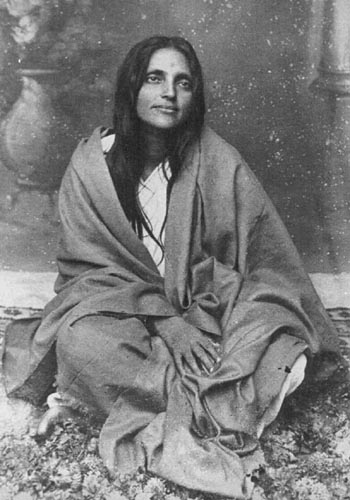
Anandamayi Ma

Thursday, February 12, 1959

Daya Ma and the others had been planning to visit the Mother on Friday, but changed their minds on learning that Saraswati puja was a special day at the Agarpara ashram.

We arrived there at about eleven in the morning. Daya Ma was as anxious as I’d been to internalize the experience. She didn’t want it turned into a ceremonial encounter between two heads of religious organizations. At her request, therefore, care was taken not to disclose her identity and those of the other sisters. The three of them took their seats a bit away from the crowd, and at a distance from the Mother. I sat at the back of the crowd.

Standing up at one point to locate the sisters, I caught the Mother’s eye. Sitting down again, I found my meditation instantly deepening.

Swami Kriyananda and Anandamayi Ma

Swami Kriyananda and Anandamayi Ma

Public curiosity about us couldn’t be stifled. When the puja ceremony had ended, people approached Prabhas-da (Master’s cousin) and Mohini Chakravarty and asked who we were. Thus the truth came out. Daya Ma and the rest of us were immediately invited to come up on to the platform and sit near the Mother, who blessed each of us, giving Mataji a garland, and the rest of us, roses.

Many people came forward for Her blessings. One woman pressed many gifts on Her, but not in a spirit of devotion. The Mother turned away from her to face us. Her magnetism drew us into a meditative state.

Then She asked me to sing. Nervously at first, I complied by singing Ram Proshad’s beautiful song, in Bengali, “Will that day come to me, Ma, when crying, Mother! my eyes will flow with tears?” I soon lost myself in the inspiration of the words.

“Most beautifully sung!” exclaimed the Mother at the song’s end. Turning to the crowd, She remarked concerning us, “They are soft!”

Then, rising, She told us, “Please remain seated. I will be away only for a little while.”

After She’d left I sang Master’s chant, “In the Valley of Sorrows,” in English. She returned after I’d finished, and told me, “I was listening to you. Please sing it again.”

I did so, then sang two other songs in Bengali: “Blue Lotus Feet,” and “Take Me on Thy Lap, O Mother.”

“What sweetness you express through your singing,” She exclaimed.

I said, “It gives me much joy to be able to sing for you,” to which She replied:

“Joy cannot be measured in terms of ‘much’ or ‘little.’ It is absolute.”

A devotee then sang a devotional song in Hindi. While the woman was singing, the Mother looked at Daya Ma long and deeply. Afterward, She remarked to the crowd, “Look, here you see an example of the unimportance of understanding the words literally. These Americans have not literally followed a single word of the Hindi song. But see how, overcome by the spirit of the song, water is flowing down their cheeks!” She tossed Daya Ma a garland, then gave us all garlands. Of Daya Ma She said, “She has come a long way to make this contact. Her meditative state is beautiful.”

The time came at last for us to leave. Using the Bengali expression for “goodbye,” I said, “Tabe asi” (literally, “Then I come” again).

“To say you will come again,” She replied with a gentle smile, “implies that we shall be separated for a while. But there can be no separation between us.”

Friday evening, February 13th

I postponed my trip to Madras, so as to take the fullest possible advantage of Mother’s stay near Calcutta.

Friday evening I went again, accompanied by Mohini, but without the others. The Mother asked me to chant again. I sang “Blue Lotus Feet,” and, “Will That Day Come to Me, Ma?” Later, still under the impression that I, rather than Daya Ma, had requested an interview, She asked me if I didn’t want to see Her privately. At first, embarrassed to take up Her time, I declined, but almost immediately corrected myself and said ‘Yes’.

Mohini came into Her interview room with me to act as a translator. But once we got there, I could think of nothing to say! Then I remembered that Brother Turiyananda, in America, had told me the only thing he wanted from India was Anandamayi Ma’s blessings, and some item that She had used. I made this request for him.

“Very well,” She replied.

“Also,” I continued, recalling a problem that was bothering me, “my sadhana has been a little difficult in recent weeks. Might I have your blessings, and any advice that you’d care to give me?”

Mother: “Always think the Divine grace is with you. Depend on it, and you will never find it wanting.” She paused, then continued, “Now, then, tell me what you want me to give you of my belongings.”

I: “Mother, that is for you to say.”

Mother: “No. Take anything — bed sheet, shawl — anything.”

I hesitated.

She: “Will you be shy about asking from your own mother ?”

I: “But please, I don’t know what you need most.”

She: “I don’t need anything!”

I: “Please, at least let one of your devotees choose for you.”

She: (firmly) “No, you must choose. Are you not my own?”

I: (wanting to make the smallest request possible) “Then Mother, might I have a handkerchief?”

An attendant rose instantly to fetch one for me. Thinking suddenly how nice it would be to have a memento of my own, I said hastily, “Mother, might I have two handkerchiefs ?” Everyone laughed.

Mother: (taking off Her shawl and giving it to me) “Here, this is for you. I have worn it for five years.” She gazed at me lovingly. Then, in Her mood to give me more, She ordered the attendant to bring me a flower bouquet also. Of the shawl, She told me, “Wrap your body with this shawl, but always remember that Nama — God’s Name —— is the best thing in which to wrap yourself.”

Overcome with emotion, I held the shawl silently to my heart for some moments. Then I told Her, “We all feel we are not meeting you for the first time.”

Mother: “The more you advance in meditation, the more you will realize your identity with me.”

I: “Mother, would you give me some personal advice for my spiritual practice?

She: “Always practise japa (taking God’s name). Keep your mind busy chanting God’s name, and you won’t have time to think of anything else. Say, ‘Hari! Hari!” — here She clapped her hands joyfully once, as if to indicate that everything of this world disappears with the thought of God — “or any other mantra you like. Filled with His joy, you will laugh at all dangers.”

I: “I like to take my Guru’s name.”

She: “That is good. Everything you have attained has come to you through his blessings.”

I was so full of inner joy by this time that I could only close my eyes in meditation. While I meditated, the Mother spoke briefly with Mohini. He told Her that I and the others in our party meditated five or six hours a day.

Mother: “I can see that. Your American brother and sisters are highly advanced in the spiritual path. Daya Ma, especially, enjoys perfect calm, both inside and outside.”

I: “Mother, you are so good.”

Mother: (sweetly) “It takes goodness to see goodness.”

She gave me the bouquet She had ordered, and the handkerchief, adding to them a large towel.

Love filled my heart.

Tamar chhele khub kusi,” I said as we left, meaning, “Your child is very happy!”

Saturday, February 14th

We went again to Agarpara this evening. Mother asked me to sing “Blue Lotus Feet” for Her again. I sang it gladly.

Mother: “How many times I have asked him to sing this song! In spite of so many repetitions, it never loses its charm.”

Later I told Her, “Daya Ma would like to spend some time with you alone — not to talk; just to meditate.”

Mother: “She is always welcome.”

I had brought a scarf to give Her. Hesitantly I gave it at last, whereupon She said playfully, “I was going to snatch it from you, but waited to see if you would give it!” She then asked me to put it around Her shoulders.

When I had done so, she repeated ten times, solemnly, “Tamar ghare ami thaki” — “I dwell in your heart (literally, room).”

“I know,” I said, thinking of a blessing I had received from Her in meditation that morning. I added, “Ami tomar chhele — I am your child.”

She: “This is not a new relationship. It is eternal.”

I: “I know.” I was thinking both in the human sense, and of Her as a manifestation of the Divine Mother.

In time I became known affectionately as Her “chhoto chhele — little child.”

Many were the meetings we had over the months and years after that. Always She showered me with grace. One time She said, “Many thousands have come to this body. None have attracted me as you have.” The translators emphasized several times to me that she had said, “None.”

Another time She said, “There are people who have been with me for twenty-five years and more, but they haven’t taken from me what you have.”

And to others I’m told She once said, “Here is a lotus in a pond. Many frogs sit under the lotus, croaking. Then a bee flies in, takes the honey, and flies away. Kriyananda is that bee.”

She surprised me once by asking, “What would you say if I asked you to stay here?” Why did She ask me that? Perhaps She saw what I would suffer from my Guru’s organization. But even had I known what the future would bring, I would have faced that suffering rather than forsake my dedication to him. Perhaps She didn’t want me to devote my life to service, but purely to sadhana.

I could have remained faithful to Master in Her ashram. Certainly She would not have asked me to leave him; that is not Her way. But I couldn’t set aside his words to me: “Your life is one of intense activity — and meditation”; his statement, “Your work is lecturing and writing; and his frequent charge to me, “You have a great work to do.” Moreover, I had dedicated this incarnation to spreading his work. I live for nothing else.

After my separation from SRF, Anandamayi Ma later told me, She would gladly have taken me in. But Master himself seems to have prevented that possibility, for I was not granted an Indian visa for ten years.

Nevertheless, Anandamayi Ma occupies a more than special place in my heart. I see Her as the Divine Mother Herself. Through Her, next to Master, I have received the greatest blessings in my life. Indeed, with Her I was able to have the relationship that my greenness on the path never permitted me to have with Master during his lifetime. It was a relationship which, far from taking me from my Guru, served to deepen my relationship also with him.

Posted in anandamayi ma, anandamoyi ma, ramprasad, yogananda | Tagged , , , , , | 4 Comments

My First Meetings with Anandamayi Ma, by Swami Kriyananda, part 1

My First Meetings with Anandamayi Ma, February, 1959
by Swami Kriyananda
originally published in Ananda Varta, October 1983

Swami Kriyananda with Anandamayi Ma

Swami Kriyananda with Anandamayi Ma

The following is based on a long letter I wrote — but never completed — to the SRF monks in Los Angeles, on notes that I made after each meeting with the Mother, and on accounts contributed by Mohini Chakravarty, an SRF/YSS devotee. ~Swami Kriyananda

Sri Daya Mata and her party, consisting of Ananda Mata, Sister Revati, and myself, had been visiting Sri Yukteswar’s seaside hermitage in Puri. On about February 9th, we returned to the YSS Baranagar ashram, outside Calcutta, where we were living. Soon after our arrival, we learned that, during our absence, Anandamayi Ma had come to Calcutta.

What a thrill! Paramhansa Yogananda’s beautiful account of Her in Autobiography of a Yogi had inspired all of us, his disciples, with Her example of divine love, with Her ecstatic absorption in God’s infinite Bliss. One of our greatest hopes in coming to India had been that we would have the opportunity of meeting Her. Now Divine Mother had brought Her figuratively to our door- step! We looked forward with keen anticipation to meeting Her.

Swami Kriyananda and Anandamayi Ma

Swami Kriyananda and Anandamayi Ma

My own eagerness, however, was not unmixed with a certain anxiety. On Friday of that week I. was scheduled to fly to Madras to lecture at the SRF/YSS center there. Would I be able to see the Mother before then? It all depended on whether I could find someone to take me to Her, as I had no way of getting there on my own.

On Wednesday evening, February 11th, the four of us were sitting with two or three Indian friends around the dining room table. Talk turned (inevitably!) to Anandamayi Ma, and to our prospects for visiting Her. “But,” we lamented, “we’ve no idea where She’s staying !”

“It must be in Agarpara,” said Mohini Chakravarty, one of the friends who were present. “That’s where She stays when She comes to Calcutta.”

“Do you know how to get there ?” I asked.

“Yes, I could take you.”

“At what time does She generally see people ?”

“At about this time.”

This was not an opportunity to let slip away! I said, “Why don’t we go there right away ?”

My proposal was a bit sudden for the others in our party, but Mohini agreed to accompany me, and minutes later we were on our way.

I meditated as we drove through the darkness. A peculiar joy filled me. Did the Blissful Mother already know we were coming ? Was She blessing me before I even met Her?

“Mohini,” I said, “please don’t tell the Mother who I am (that is to say, a disciple of Paramhansa Yogananda, who was of course well-known to the Mother’s devotees.) I don’t want the formality of an introduction. Let me just slip quietly into the back of the room and sit there in meditation. That will be a sufficient joy for me.”

I wanted a spiritual, not a social, contact with the Mother. Also, I felt timid at the thought of representing Master before such an exalted Being, unworthy disciple as I am. Better just to come in and sit unnoticed.

I saw Her first through a series of french doors which run the length of one wall of the assembly hall. At once, and every time I saw Her again during the days to come — even in semi-darkness, when I couldn’t distinguish Her features — I understood anew the meaning of Master’s words when he wrote of the blessing that flows from the mere sight of a saint. There was no mistaking it. I was beholding a truly divine Being.

I slipped quietly into the room and sat cross- legged on the floor at the back. There must have been about 150 people present. The Mother was speaking and laughing amiably. Her voice, as pure and bell-like as a little girls, thrilled my heart. I closed my eyes in meditation. Soon I began to lose myself in inner peace and devotion.

After a time, the congregation stood up. The meeting had obviously come to an end. I couldn’t bring myself to move or to open my eyes, but the people around me began talking, so I assumed that the Mother had left the room.

I hadn’t wanted to be introduced to Her, but now that She had retired I thought a little sadly, “It would have been nice to exchange just a glance with Her — even a loving smile!” But She was gone now. And who was I, anyway, to expect any favours? I contented myself with the inner blessing I knew I’d received.

I continued meditating for several minutes. Then Mohini tapped me on the arm.

“I am going to inquire if the Mother can be persuaded graciously to come out again and meet you.”

“No!” I exclaimed, “please don’t! It would be too much of an imposition. Her evening with the public is over. Who am I to deserve special favours?”

But Mohini lovingly disregarded my reluctance. (He knew what I really wanted!) Approaching one of the Mother’s devotees, he made his request. Presently word came back that She would see me. I went and stood by the door of Her room, my heart beating with a mixture of dread and joy.

As I stood there, Sri Anil Ganguli, a devotee of the Mother, sounded a note of mock warning: “Beware of the cobra’s poison. Once you get it into your system, you may never be able to get it out again!”

Presently She came out. Sweetly she asked where I had come from, how long I had been in India, and a few questions of a general nature. I told Her that I am a disciple of Paramhansa Yogananda, adding that, thanks to Him, all of us in his ashrams in America felt great love for Her.

At this She smiled appreciatively, then added quietly, “There is no love except the love of God. Without His love, it is not possible to love people.”

This answer, and the way She uttered it, so thrilled me thatI could make no reply, but only smiled happily.

After a few moments, She asked me when I was planning to return to America. I replied, “We’ll all be going back to our ashram in April.”

“Our ashram? Can you tell me where your ashram is, that you must go back to it?”

With a smile of appreciation, I corrected myself. “This body is my ashram, because it is here I sit for meditation.”

“No. Why your body ? Your body is temporary. Ashram is everywhere. It cannot be limited.

“In a spiritual sense,” She continued, “the meaning of the word, ashram, is, ‘ar shram noy’ — cessation from all compulsory activity. In this effortless divine state, all is perceived as one.

“In another sense, ashram refers to the four stages of life [brahmacharya, grihasta, vanaprastha, and sannyasa]. But the Divine can be known in all of these states, So these, too, are all one.” Everything is one — all one.” (That last word, “one,” she uttered in English, laughing merrily at Her own use of a foreign word.)

Mohini said, “Brother Kriyananda asked me on our way here to let him just come in quietly and meditate, and not to tell you who he is.”

The Mother, gazing at me quietly and affectionately, replied, “But I saw him come in, even though he was unannounced, I was watching him meditate.

“What do you mean, however, by the expression, ‘Who he is’? Who is he, indeed, anyway? Who is anybody? This little girl [the Mother, I learned, generally referred to Herself in this way] forgets Herself so much She can’t even remember who she is supposed to be! Occasionally, someone who has been close to this body for years will be sitting nearby, and I Will ask, “Where is So-and- so ?”, calling this person by name. Sometimes people are disappointed when I don’t recognize them, but it is because I don’t use this mind as others do. I am led by kheyala – by moods!” (Again She used the English word, moods, and laughed happily. By ‘moods’, however, She didn’t mean that She is moody in the ordinary, human sense. But just as human moods are irrational and unpredictable, so the kheyala is above reason and is not dependent upon the logical pro- cess for its perceptions and decisions. Kheyala may sometimes seem whimsical to the limited intellect, but it never is.)

The Mother mentioned that the following day was the festival of Saraswati puja (worship). Saraswati is the Hindu goddess of learning and music. The Mother urged me, if I could, to attend the function.

Mohini then told Her that I could sing a few devotional songs in Bengali. She replied, “That is very nice. But it may not be possible to listen to them tomorrow. We shall certainly be able to hear them the following day.”

“But,” remonstrated Mohini, “our brother’s difficulty is that he is scheduled to leave for Madras on Friday morning.”

Impulsively I intruded, “I am supposed to leave then. But I am seriously considering postponing the journey.”

Everyone, including the Mother, laughed appreciativelv. Sri Ganguli remarked, “Aha! What did I say ? The cobra poison has begun to take effect!” Everyone laughed again.

Mohini then relayed the wish of Daya Mata to meet the Mother privately. Because the Mother had not yet met Daya Ma, she somehow got the impression that it was I who wanted the appoint- ment.

“Father,” She replied, “you know I do not like to bind myself with appointments. Once I make a promise, I must keep it regardless of all other considerations. Please speak to Swami Paramananda downstairs and ask him to make the appoint- ment for me.”

She rose to leave. With a full heart I thanked Her in Bengali for having come out again especially to see me.

The Mother smiled. “ ‘Thank you’ is too formal,” She remarked. (In Bengali the expression is used less frequently than in English, and has a formal ring to it : ‘dhanvawad’.) “Will you thank your own self?” When I looked puzzled as to what I might offer as an alternative, She addressed Mohini: “Ask him, would he thank his own mother?”

“Yes,” I replied after Mohini’s translation, “in English it is customary to show appreciation in this way, even to our loved ones,”

The Mother, smiling, then conceded, “Well, if it is customary with you it is all right.”

Lovingly She gave me a flower and a tangerine, upon which I said with a smile, “Now — what can I say to you? Must I accept these in silence?”

She replied with a gentle laugh, “Say what you want. It is all the same.”

I thanked Her in English. (I guess I’m just too much of a Westerner!) Then, with a full heart, I said how happy I was to have met Her. As She turned to go, I touched Her feet lovingly. (Later I was to learn that it is strictly against the ashram rules for anyone to touch Her feet. But no one, least of all the Mother Herself, corrected me for my unwitting breach of etiquette.)

My heart was full. Eagerly I looked forward to the following day, when I planned to urge the rest of our group to come, too; and attend Saraswati puja at the ashram.

Part 2

Posted in anandamayi ma, anandamoyi ma, kriyananda, yogananda | Tagged , , | Leave a comment