Shakti: Realm of the Divine Mother

There is a beautifully written book on the various energies and forms of the Divine Mother — authored by Vanamali, a long time friend of Swami Kriyananda and Ananda. In Shakti: Realm of the Divine Mother, she covers the philosophical and spiritual basis of the Mother aspect of God, along with stories and explanations of specific aspects of the Cosmic Mother. I highly recommend this book for those interested in deepening their understanding and devotion.

Here is the Foreword written by Swami Kriyananda, where he writes about the need for worship of God as Divine Mother (shared with permission from Vanamali):

Mata Devi Vanamali—Mataji, as I shall refer to her hereinafter—is a fit person to write about the Divine Mother of the universe. Mataji is a deep devotee who is also filled with India’s ancient concept of wisdom or jnana. Because my own devotion to God finds particular expression to the Divine Mother, I was deeply touched when Mataji asked me if I would write a few words of introduction to this beautiful book.

There are two aspects of the important subject of the cosmic mother: the scriptural and the experiential. Mataji has rightly given us the scriptural slant on the subject. In this age, when most of us think of God as “He,” it is necessary to point out, as Mataji has done, that God is neither He nor She, and at the same time God is both! In the words of a great Kaali bhakta (devotee) of Bengal, Ram Prasad, “A thousand Vedas declare my Tara [a name for the Divine Mother] is nirakara [without form].”

Yet religion in these times has become too rationally formal and therefore too rational altogether. Years ago in America, the inspiration came to me to spread the concept of God as mother and not only as father. I wasn’t thinking of the Virgin Mother only, as is more common in the West, but of the formless infinite in its motherly aspect. I went to many Western shrines dedicated to the Divine Mother and worshipped in them. I received in each of them great inspiration and love. And I say now, is it not time for dogmatic religion to be replaced by devotion and love? There has been too much thinking about God. Mankind must learn to love Him, to talk with Him, and to experience Him. And that “Him” needs to be understood first in its higher impersonal aspect and then brought down to earth in its more truly personal aspect as the Divine Mother.

For God is inherent in “His” different aspects, though each in essence is different from every other aspect. It matters not only how we ourselves look upon God and define Him in our minds; it is also a question of how God views us. If we invoke God as the Divine Mother, She comes closer to us. The infinite—which is beyond all sexual differences, comprising the maternal as well as the paternal principle—opens its heart to us when we appeal to it as mother.

There is a story from the life of that same poet, singer, and saint Ram Prasad. He was mending the fence in front of his house. At one point, his daughter came up to him and offered to help with his job. He had been singing. She said to him, “Whom have you been singing to, Papa?”

“I’ve been singing to my Divine Mother,” he replied. “But she’s very naughty. I keep calling and calling her but she won’t answer!”

“If she doesn’t answer, Papa, why do you waste your time calling to her?” The little girl then ran off with a childish laugh.

When Ram Prasad came indoors later on, he told his wife how their daughter had come and helped him with the fence and talked to him playfully.

“But that’s not possible,” answered his wife. “Today she’s visiting on the other side of our village.”

“But I know it was her,” he exclaimed. Later on when their daughter returned home, he pressed her, “Wasn’t it you helping me with our fence today?”

“Why no, Papa. You can ask anybody. I was with friends on the other side of our village.”

Thus did Ram Prasad come to know that the Divine Mother herself had come to him and teased him.

“O my Mother!” he cried. “What a naughty dear you are! Though you pretend to be inaccessible, you are ever near me and, Mother, ever dearest to me.”

All aspects of God hear us when we pray, but the Divine Mother listens to us—I don’t say more so but more particularly. For we are her children. She cares for each one of us specially. When we err, she spanks us through the law of karma. But when we love her, she also forgives. For she is ever anxious for us to understand that we may return with outstretched arms to her lap of infinity!

  — Swami Kriyananda

Posted in cosmic mother, Devi Vanamali, divine mother, hindu, Hinduism, kriyananda, ramprasad, yogananda | Tagged , , , , , , , | 3 Comments

Two Visions of Kali

The following two visions of Kali—one by Paramhansa Yogananda when he was the young Mukunda and the other by the Bengali poet Ramprasad Sen—are described by Swami Kriyananda in his book Paramhansa Yogananda: A Biography.

These two stories highlight an important feature of God: even though Kali is normally depicted in painting and statue with a specific form, features, and personality, She can take on any form. In Yogananda’s vision she was “beautiful.” Ramprasad saw Her as a young girl. Of course She is without form, and in all forms. This chant wryly chides those who would limit the Divine Mother to any single form:

Who tells me Thou art dark [referring to the dark-skinned Kali], Oh my Mother Divine,
Thousands of Suns and Moon from Thy body do shine!

~ Nayaswami Devarshi

*         *         *         *         *         *         *

Mukunda, as I said, worshiped God especially in the form of Mother of the Universe. Because his friends knew this was the focus for his devotion, they would happily bring him news of any new Kali temple they found in the vicinity. One day they came to him bearing tidings of a new temple.

Mukunda smiled. “You all go, if you like. This evening I prefer to stay home.”

“Stay home! But why?”

Mukunda only smiled. His friends went to the temple, prostrated themselves before the image it held of the Divine Mother, and chanted a few devotional songs. Their hearts were uplifted, but the upliftment lasted only for that evening.

At home, Mukunda went up to his attic room. Temples, too, have value, primarily as aids to bringing people’s devotion to a focus. But Mukunda’s devotion had long since achieved that focus at the point of superconscious ecstasy in the forehead—that is to say, in the frontal lobe of the brain behind that point.

Lithograph of Kali from Calcutta, c. 1895

Lithograph of Kali from Kolkata, c. 1895

“Mother with lotus feet!” he prayed. “Mother with hair spreading out over all creation! O Mother, come to me! Mother, your smile twinkles in a million stars. O Divine Mother, tear asunder this veil of darkness which hides You from me!”

Long he called to Her. Years earlier, when he had lost his earthly mother, his aching love for her had been redirected to the Divine Mother of the Universe. (Wise Child! Instead of grieving over our earthly losses, we should direct our love to God, where every pain becomes a blessing.) And now at last that Mother of all mothers had appeared to him!

“Kali!” he whispered. “Mother Kali, You have come! Oh, how beautiful You are! Mother, may my life be a song of constant love for Thee!”

The Divine Mother smiled. “Your prayer is granted, My child. Though you shall have to travel far, and bring many souls to My all-sheltering arms, in your heart of hearts you will always be at rest in My formless presence. And as often as you call to Me, whenever you desire it, so often shall I appear before you in this form.”

Mukunda (Yogananda) called Kali, when seen in vision, “beautiful.” But certainly the images presented of Her are anything but that. She is depicted with four arms, a garland of skulls, her hair unkempt and straggling out in all directions, her tongue lolling out of Her mouth, standing (as if in triumph, as the Westerner would perceive her) on the prostrate form of Her husband, Shiva. All this, however, is deeply symbolic. The English thought of Her as the goddess of death, the form worshiped by Thuggees (a band of criminal assassins). Yogananda explained this symbolism to us:

Kali represents Mother Nature. Her four arms symbolize Creation, Preservation, and Destruction, the fourth depicting the gift of salvation to those who go beyond Nature to the heart of Infinity. The garland of skulls signifies Her divine omnipresence in all human minds. Why skulls? Because all human life is temporary. Her hair streaming outward signifies God’s energy reaching out through all Creation. In Her dance, the rhythmic steps signify the vibratory nature of Creation. Her husband Shiva is depicted as lying prostrate, because God the Father, the Eternal Spirit, is beyond Creation, beyond all vibration, alive in the vibrationless void of Brahman (Spirit).

Kali’s dance ceases when Her light footsteps touch the breast of the Infinite. The reason She is shown with Her tongue out is that She suddenly realizes She has gone too far! Finitude cannot penetrate into the heart of Infinity.

In India, one bites his tongue, sticking it out a little beyond the teeth, when he is conscious of having made a mistake. Even in Western countries, this is a common, instinctive gesture.

Needless to say, many Indians, too, fail to understand this deep symbolism, and assume that Kali’s tongue is lolling out in blood lust; that her streaming hair suggests almost a harridan raging about to find whom she may devour next. The garland of skulls suggests to them, again, blood lust. And the four arms seem to serve no purpose at all. Her position, standing on Shiva’s breast, is taken for a posture of victory.

Indian images of God are often deliberately not beautiful, in order that the devotee may not be deluded into thinking that any image can ever define the Infinite. The images of Kali are certainly not beautiful. Yet She has been worshipped by many great saints and masters, including Yogananda and Sri Ramakrishna.

Ram Proshad, a great poet-saint of the seventeenth century, worshipped Kali also. One day he was mending a fence on his property, when his daughter came and helped him. He’d been singing. His daughter asked him, “To whom are you singing, Daddy?”

“I am singing to my Divine Mother Kali. But she’s very naughty! Though I often sing to Her, She never comes to me.”

“If She never comes, Daddy, why do you keep on calling? Isn’t it all a useless waste of time?” With a light laugh, his daughter then ran away.

Later that day, his job finished, Ram Proshad went indoors. There he told his wife how their daughter had been helping him. The wife replied, “That isn’t possible. She’s spending the whole day on the other side of town with some friends.”

When their daughter returned that evening, he questioned her. She answered, “Daddy, you can ask anybody. I wasn’t here. I was far away, on the other side of town.”

And then Ram Proshad realized that it had been his Divine Mother, coming to him in the form of his daughter, and teasing him by saying, “If She never comes, why do you keep calling to Her?”

So you see, Kali comes in many forms, and rarely, if ever, in the form one beholds in the temples. She can also be infinitely kind, friendly—even teasingly playful! Her eyes, however, though childlike, reveal also the deep, ego-free calmness of Infinity.

— from Paramhansa Yogananda: A Biography

Posted in cosmic mother, divine mother, kali, kriyananda, prayer, ramprasad | Tagged , , , , , | 2 Comments

The Cosmic Mother as AUM

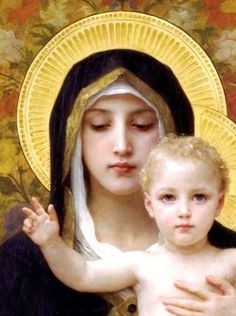
Madonna and Child, William Bouguereau (1825-1905)

Madonna and Child, William Bouguereau (1825-1905)

Paramhansa Yogananda described the AUM vibration as the Divine Mother. He said that one must go through AUM/Mother in order to reach cosmic consciousness.

In our article about Kali, he states that, “Kali represents Mother Nature. She is Aum, the cosmic vibration. In Aum everything exists—all matter, all energy, and the thoughts of all conscious beings. Hence, Her garland of heads, to show that She is invisibly present in all minds.”

Here he goes more deeply into the process of becoming one with AUM, and in this instance compares AUM to the Divine Mother as Mary, the Mother of Jesus.

~ Nayaswami Devarshi

*       *       *       *       *

“Once the mind is interiorized, and withdrawn from its identification with the world and with the body, the inner light comes into clear and steady focus. The inner sounds become all-absorbing. Aum fills the brain; its vibration moves down the spine, bursting open the door of the heart’s feeling, then flowing out into the body. The whole body vibrates with the sound of Aum.

“Gradually, with ever-deeper meditation, the consciousness expands with that sound. Moving beyond the confines of the body, it embraces the vastness of infinite vibration. You realize your oneness with all existence as Aum, the Cosmic Vibration.

“This state is known as Aum samadhi, or union with God as Cosmic Sound. Aum is that aspect of the Christian Trinity which is known as the Holy Ghost, or Word of God.

“By still deeper meditation, one perceives in the physical body, underlying the Aum vibration, the vibrationless calm of the Christ Consciousness, the reflection in creation of the unmoving Spirit beyond creation.

“In ancient spiritual tradition, the Christ Consciousness is spoken of as the Son. For just as, among human beings, the son is a reflection of the father, so in cosmic consciousness the Christ–in Sanskrit called Krishna, or Kutastha Chaitanya–reflects in all things the consciousness of God, the Father, beyond creation.

“By ever deeper meditation, one expands his awareness of the Christ Consciousness beyond the limits of the body to perceive his oneness finally with the Christ Consciousness, which underlies the manifested universe.

“By deeper meditation still, one goes beyond creation and unites his consciousness with that of the Father, Satchidananda, the vast ocean of Spirit.

“In these progressive stages of realization are discovered, in reverse order, the three aspects of the Trinity: Father, Son, and Holy Ghost.

“Jesus was called the Christ. Most people are not aware that Christ wasn’t the name given him at birth. It was a title signifying ‘the anointed of God,’ or, ‘chosen by God.’ (Luke 23:35)

“In the same way, Krishna in India was really Jadava the Krishna–or Christna, as it is sometimes written to show that the meaning is the same.

“Jesus was a master. He had attained Christ Consciousness. Anyone who attains that state of consciousness may justifiably also be called the Christ, for he has dissolved his ego in the infinite consciousness.

“Aum, the Holy Ghost, is also referred to in ancient traditions as the Mother, for it represents the feminine aspect of God.

“The Roman Catholic Church teaches that one must go through the Mother to reach Christ. To them, of course, the Mother signifies Mary, the mother of Jesus. For all that, the truth is there, though far deeper than the generally accepted understanding of it.

“For, to reach Christ Consciousness, you must first unite your consciousness with Aum, the Cosmic Vibration.

“Self-realization means the realization that your true Self is not the ego, but God, the vast ocean of Spirit which manifested for a time the little wave of awareness that you now see as yourself.”

—Paramhansa Yogananda in The Essence of Self-Realization

Posted in yogananda | 1 Comment

A Serious Grievance

Paramhansa Yogananda taught a way of praying that many people found unusual. In his Whispers from Eternity he called his prayers “prayer-demands,” describing the proper attitude towards prayer. He said that we are children of the Infinite and that divine freedom and bliss are our divine birthright. He urged us that we should demand our entire divine birthright rather than meekly requesting a few paltry offerings.

In one recording of Yogananda, he prays with a loud booming voice, “Lord, thou hast created us against our will! Free us! That is our prayer!” Another time he told his students, “Give your faults to God. He likes that.”

This poem by Ramprasad Sen reflects Yogananda’s approach in the way that it blames Divine Mother for our troubles, though here it is done with the teasing humor often used by Ramprasad.

~ Nayaswami Devarshi

A Serious Grievance
by Ramprasad Sen

I have a serious grievance to settle
with the Mother of the Universe.
Even while apparently awake,
with you as my all-protecting Mother,
the house of mind and body
is ransacked by robbers,
my countless egocentric impulses.
Every day I resolve to repeat your name
as the most powerful defense,
but forget my good intention
just as the intruders arrive.

I have caught on to the playfulness,
0 Mother, by which you elude my willful grasp.
You bestow no power of inward prayer upon this child,
so you receive no consistent devotion from me.
I no longer regard this as my fault.
Only what you give me can I return to you
as the sweet offering of divine remembrance.
Fame and infamy, good and bad tastes of life,
all phenomena are your graceful play.
Yet as you dance in ecstasy,
we are thrown into quandary.
0 Goddess, lead us on your wisdom way.

This poet dares to sing her secret:
‘Mother Mahamaya places a twist in every mind,
making it perceive the ashes of egocentricity
as an abundance of candy,
which it tastes with constant disappointment
and shocked surprise.
Awaken now and be free.’

from Mother of the Universe by Lex Hixon

Posted in divine mother, prayer, ramprasad, yogananda | Tagged , , , | 3 Comments

Ramakrishna on Divine Mother

Sri Ramakrishna Paramahansa

Sri Ramakrishna

“The Divine Mother revealed to me in the Kali temple that it was She who had become everything. She showed me that everything was full of Consciousness. The image was Consciousness, the altar was Consciousness, the water-vessels were Consciousness, the door-sill was Consciousness, the marble floor was Consciousness — all was Consciousness. I found everything inside the room soaked, as it were, in Bliss — the Bliss of God. I saw a wicked man in front of the Kali temple; but in him also I saw the power of the Divine Mother vibrating. That was why I fed a cat with the food that was to be offered to the Divine Mother. I clearly perceived that all this was the Divine Mother — even the cat. The manager of the temple garden wrote to Mathur Babu saying that I was feeding the cat with the offering intended for the Divine Mother. But Mathur Babu had insight into the state of my mind. He wrote back to the manager: ‘Let him do whatever he likes. You must not say anything to him.'”

—from The Gospel of Sri Ramakrishna by “M”

Posted in dakshineswar, divine mother, kali, ramakrishna | Tagged , | 3 Comments

“Ask of Me Salvation, but not My love and devotion”

Paramhansa Yogananda sang a Bengali chant that was translated into English as:

Oh devotee, I can give thee salvation,
but not My love and devotion;
for when I give those away, I give Myself away.
Ask of Me salvation, but not My love and devotion;
for when I give those away, I became poor, walking on your heart’s wave.

Swami Kriyananda explained the meaning of this chant in a talk that he gave:

“Divine Mother is very conscious of you, and especially of your soul’s needs. She will help you, but She will help you more if you ask from Her that which She really wants to give. Master [Yogananda] put it in a beautiful way when he sang a certain song in Bengali. Somehow he gave me the power to remember his words. I even remembered this song well enough so that ten years later when I went to India and learned Bengali, I realized that I had learned it exactly right.

“The song was, “Oh devotee, I can give you salvation, but don’t ask my love and devotion. If you ask for those, and if I give them away, I become poor because then I give myself away. So ask of me any gift, ask of me even salvation, but don’t ask me for my love.” Of course, the meaning is that Her love is what you really should ask for.

“Ask for love, ask for God’s love, ask for Divine Mother’s love. There’s nothing else worth praying for, even salvation. It’s not important whether you’re living in this world or in another world. Be in love with God.

“There’s a beautiful thing that St. Theresa of Lisieux said: “I want to go to hell because I want there to be at least one person in hell who loves God.” Have that longing for devotion. If you pray for anything, pray for devotion. If Master brought anything to us, above everything else, it was that love of God.”

Further Resources

Posted in cosmic mother, divine mother, kriyananda, yogananda | Tagged , , | Leave a comment

“Who tells me Thou art dark…?”

Thousands of Suns, painting by Mantradevi based on Yogananda's chant.

Thousands of Suns, painting by Mantradevi based on Yogananda’s chant. See more of Mantradevi’s art.

Out of emotion or sentiment, people are prone to make Divine Mother so humanly personal as to become small. The Divine Mother is beyond form and beyond human sentiment. Yogananda used to sing a chant:

Who tells me Thou art dark, oh my Mother Divine?
Thousands of suns and moons from Thy body do shine.

That song is more than just a devotional chant, but a deep teaching (and also a play on words). He explained that Divine Mother is worshiped in Bengal as Kali, who has dark skin. The chant is lightheartedly asking the rhetorical question “who says that you are limited to that dark form that we worship?” The response is that Divine Mother’s ‘form’ is the entire universe: all suns, moons, galaxies—everything. She cannot be limited to any form by our human ways of worship.

~ Nayaswami Devarshi

Further Resources

Posted in divine mother, kali, yogananda | Tagged , , | Leave a comment

Father-Mother-God

by Paramhansa Yogananda

Question: Is God a Father or a Mother?

Answer: God is both the Father and the Mother Principle. If we consider God as transcendental, He is neither Father nor Mother, but as soon as think of God in terms of human relations He becomes the Father or the Mother.

When God created this universe He had two aspects—the Father or positive aspect and the Mother or negative aspect. Pure reason or wisdom is the Father aspect of God. All nature that we behold is the Mother aspect of God, because in nature we find beauty, gentleness, and kindness. The flowers, birds, and the beauties of nature all speak of the Mother aspect of God—the creative, motherly instinct of God. When we look at all the good things in nature, we feel a tenderness rise within us; we can see and feel God in nature.

Reason and Feeling

Pure reason and pure feeling have intuitive qualities. Pure reason sees as clearly as pure feeling. Women have a keen intuition. They lose it only when they become overexcited. In logic or reason, if the premise is wrong, the conclusion will be wrong, but intuition or pure feeling can never be wrong.

God is often spoken of as the three aspects—Father, Son, and Holy Ghost. Holy Ghost is the Mother aspect of God. All creation is the Son. The Father and Mother aspects of God had to have a son or emblem in which to express their love. We are the children of that love. When we see a family, we see the miniature of that greater family—God represented in the father and in the mother with both father and mother expressing their love in the child.

Family Relationship

Why is it that in a family there is a mother, a father, and a child? Because that is what God is. He is Infinite Wisdom and He is Infinite Feeling. He had to have a vehicle through which He might express His wisdom and feeling. When God manifested Himself in Creation He gave His wisdom a form, and that became the Father. He gave His feeling a form, and that became the Mother.

When we give everything away to the Divine Mother and love unconditionally, then the Divine Mother comes to us. If we once feel that love in our heart which is the love of the father and the mother, and the love of the mother to the child, and the love of the lover to the beloved—then we will know that we are in the love of God.

From Inner Culture, October 1939

Further Resources

Posted in divine mother, yogananda | Tagged , | Leave a comment

Prayer, or Loving Demand

by Paramhansa Yogananda

Effective prayer must be scientific and definite in performance and must give intelligent understanding of all its factors. All those who want to demonstrate the scientific nature of prayer must first be sure that there is a God to pray to. The word “prayer” should be changed to “loving demand.” The Father made us His children, and we have chosen to be beggars. We must destroy our deficiencies and become acknowledged as His children, as Jesus did. To do that we must stop being prodigal children and retrace our steps homeward from the misery-making mainland of matter. We live in hope and die either with unfulfilled hope or broken-hearted. Very seldom does real, complete happiness dawn on the horizon of our lives.

The popular method of prayer does not reveal the psychology and art of prayer. Ordinary prayer consists of addressing our desires, half in belief and half in doubt, to an unknown God. If prayers are answered, a superstitious trust in God may result; if they are ineffective, distrust may follow. Even an answered prayer has to be tested and distinguished from a fulfillment which was coming anyway without the causal intervention and effective activity of the prayer.

The popular system of prayer is ineffective for the most part because we do not mean business. God, the Secret Knower of our thoughts, knows what selfish desires we have in our innermost mind, so He seldom manifests Himself. While the demons of sensations and thoughts dance in the temples of body and mind, it is difficult to recognize God, who remains hidden behind the veil of Silence within.

Some people pray with excited emotion and become intoxicated with the exuberance of their own passion. Such people feel satisfied by being drunk with their own blind feelings, and they think that they are inspiration from God. Such emotions often lose their force in tears, or in religious dances, or muscular demonstrations. Visitation of God through intuition is different from emotional outbursts. Emotional prayers bring activity and excitement, while devotional prayers bring the calm joy of the Soul.

So-called intellectual prayers may uplift the intelligence but not the Soul. They may give intellectual satisfaction, but they do not bring conscious response from God. He does not reveal Himself unto the theoretically wise, but unto babies, who surrender themselves, their egoism, their pride, and their mustard-seed-like knowledge before the vastness and humbleness of His measureless Wisdom.

Are Your Prayers Answered?

Do you realize that you may have been praying to an unknown God and may not have been getting any response? Have you ever taken time to think that your ordinary daily prayer to God is almost always a one-sided affair? Do you like to talk to a deaf, mute person? Do you want to go on appealing or talking to someone who never replies?

You must pray intelligently, with a bursting Soul, seldom loudly, mostly mentally, without displaying to anyone what is happening within. Pray intelligently, with the utmost devotion, as if God were listening to everything you were internally, mentally affirming. Pray on into the depths of the night in the seclusion of your Soul. Pray until He replies to you through the intelligible voice of the utmost bursting joy tingling through every body cell and every thought, or through visible visions depicting what you should do. Pray unceasingly until you are absolutely sure of the Divine contact, then claim your material, mental, or Spiritual needs from the Most High as your Divine Birthright. Don’t cry to Divine Mother like the baby who stops crying immediately his mother sends him a toy, but cry unceasingly, rending the heart of the Divine Mother like a Divine Naughty Baby, throwing away all lures and toys of name, fame, power, and possessions, and then you will find the answer to your prayers

You may say, “I know my prayers are answered, for I hear God talking to me. I have demonstrated His response to my prayers.” “Well,” I ask, “are you sure that your prayers reached God, and if they did reach Him at all, did He consciously respond to them?” What is the proof? You prayed for healing and you became well. Do you know whether your cure was due to natural causes, or medicine, or to your own or another’s prayers, bringing help from God? Sometimes there may be no causal relation between your prayer and your cure. You might have been healed even if you had not prayed. This is the reason why we should find out whether the law of cause and effect can be scientifically applied to prayer. It has been said that God responds to law. Some people have experienced this response and have said that all people who conform to the law can test and experience it for themselves. Physical laws have to be interpreted by the physical senses and judged by the understanding. Divine laws have to be comprehended by concentration, meditation, and intuition.

There comes the question: Would a conscious God, Almighty in Nature, subject Himself to be commanded by the law of cause and effect which He created Himself? Why not? The maker of all laws certainly does not want to break the laws of His own making. Of course, we must remember that, although God is approachable through the law of cause and effect, still He, being above the law of cause and effect, has the right to respond or not to respond to a mechanical prayer. God is something more than can be demonstrated in a laboratory.

To Sum Up

  1. Solitude is the price of God-contact.
  2. Knowledge of the laws of tuning the body, mind, and Soul radios to contact God is necessary.
  3. Since God is also above law, devotion is necessary to call His attention. The devotional call, if sincere, deep, and continuous, and if it is supplemented by sincere efforts at deep meditation, must bring Divine response. Devotional demand is greater than law, for it touches the heart of God and makes Him answer His naughty and good children alike. Law is based upon mathematical precision, but devotion is based upon claiming God as our own true Love, for did He not make us in His own image? Law is exacting in its demand, while Love causes God to surrender Himself to the devotee. God can never hide from the person who exercises devotion, love, the law of meditation, and the Soul-Call.
  4. Continuous personal zeal must be put forth. Whether God seems to respond or not, one must never cease loving. The beginner in devotion must not be discouraged if God does not respond to His immediate intense demands. God never fails to listen to all Soul-Calls, but He does not always respond in the way that we want Him to .He has His own mysterious ways. Besides, He consciously responds only when He is sure that the devotee wants Him and Him alone. That is why some Saints have been tested with disease, or extreme poverty, or temptation, and when found to prefer God to health, life, abundance, or temptation, then God came. If one persists long enough in seeking, one will surely find God at the end of the trail.
  5. Never mind if you cannot see Him or hear His knock at the gate of your heart. For a long time you have been hiding from Him and running away in the marsh of the senses. It is the noise of your own rowdy passions and the flight of your heavy footsteps in the material world that has made you unable to hear His call within. Stop, be calm, pray steadfastly, and out of the Silence will loom forth the Divine Presence.

From Inner Culture, April 1936

Further Resources

Posted in divine mother, prayer, yogananda | Tagged , , | Leave a comment